
Studies and assessments
Defined studies with defined deliverables, scoped to your community and written to the standard funders apply.
Every study below is a defined piece of work with a defined deliverable, so you know the cost and the product before work begins. Most are eligible planning costs under federal and provincial infrastructure programs, and we help you find the funding line and prepare the request. Studies are delivered in English or French, to the standard funders and procurement reviewers apply.
What we study
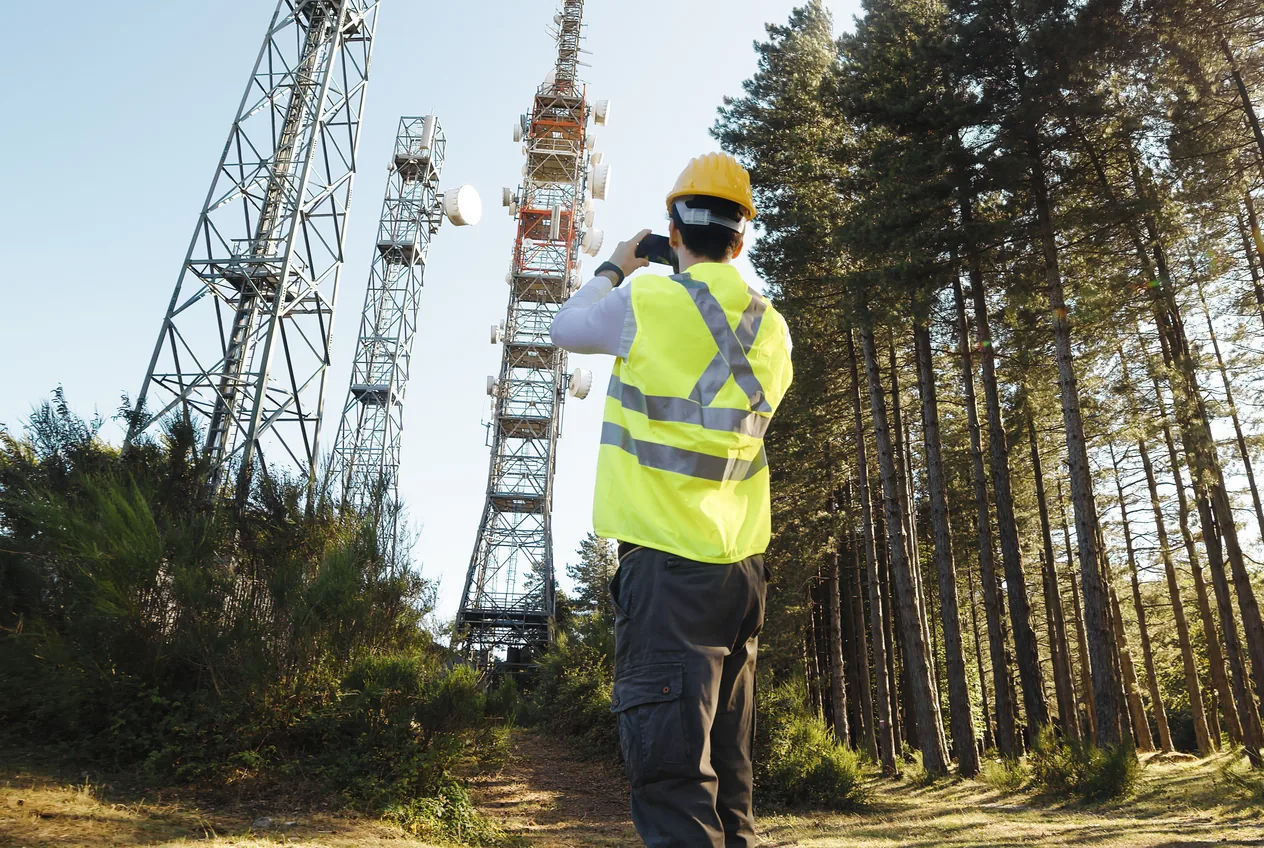
Free to start
The first two steps of the connectivity readiness assessment are free templates: a site and service inventory and a needs assessment by facility, in English and French. Fill them in on your own, or send them back to us and the assessment starts from what you have already documented. Leave your email and we send you the link.
Telecommunications and connectivity
The studies a community usually starts with, and the ones funding programs ask for.
- Start hereConnectivity readiness assessmentsites, services, contracts, needs by facility, and the documentation a funder asks for→
- Broadband technology options analysisfibre, fixed wireless, low-orbit and geostationary satellite, with life-cycle cost
- RF propagation and coverage studyVHF and UHF land-mobile radio, fixed wireless
- Fibre route and repeater-site feasibilitythe optical link and the whole site: shelter, power, access and leasing
- Satellite transport assessmentprimary or backup, and where the data actually goes
- Network audit and performance baselineLAN, WAN and Wi-Fi survey with measured throughput and latency
- Structured cabling and facility assessmentagainst ANSI/TIA and BICSI practice
- Telecom contract and SLA technical reviewwhether the contract matches the need; a technical review, not legal advice
- Funding-application technical packageUniversal Broadband Fund, CRTC Broadband Fund and provincial programs

Sample report
See what a finished IT/OT systems review looks like: ten pages of findings, figures and recommendations, emailed to you on request.
IT and information systems
- Start hereIT/OT systems reviewUnderstand, manage and govern the technology that runs your community.→
- IT systems inventory and lifecycle reviewhardware, software, licences and end-of-life dates
- Systems modernization roadmapwhat to keep, replace or integrate, and in what order
- Cloud, on-premises and data-residency options analysiswhere systems and data should live, and under whose control
- Integration and custom-software feasibilitywhere no product fits
- Business continuity and disaster-recovery assessmentwhat stops, for how long, and what it takes to recover
- IT governance reviewagainst ISO/IEC 38500
- Cybersecurity readiness reviewat the governance level; engineering with a specialist partner

Operational technology and automation
- SCADA and control-system baselineinventory, architecture, obsolescence and single points of failure
- IT/OT architecture and segmentation reviewISA-95 zones, supervisory tier only
- Telemetry and remote-monitoring options studywater, energy and environmental sites
- OT cybersecurity posture reviewIEC 62443, with a specialist partner where engineering is required
- Real-time location and asset-tracking feasibilitypeople, vehicles and equipment on a site
- Supervisory data and edge-analytics feasibilityoutside any safety-instrumented function
- Control-system lifecycle and replacement planwhat to replace, in what order, at what cost

Power and energy for remote sites
- Off-grid and remote power feasibilityfor sites the grid does not reach reliably
- Solar-plus-storage microgrid assessmentsizing, autonomy and life-cycle cost
- Backup power and resilience studygenerators, uninterruptible power supplies and autonomy targets
- Energy audit of communication and control siteswhat each site draws, and what it could
Regulated design is stamped by a licensed engineer brought onto the file.
Sample report
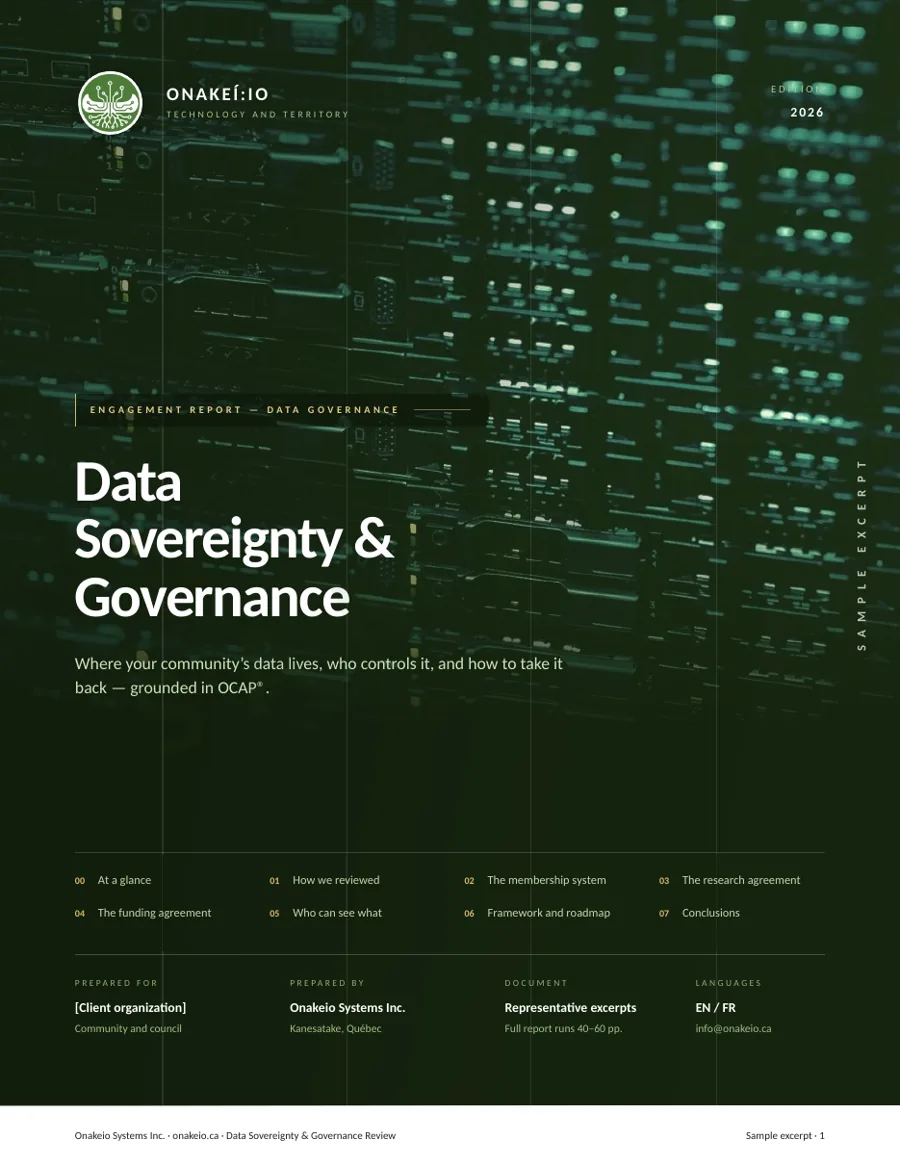
See what a finished data governance review looks like: eleven pages of findings, figures and recommendations, emailed to you on request.
Data governance and sovereignty
- Start hereData governance and digital sovereignty reviewEstablish and enforce ownership over community data, and the rules for who may access it.→
- Data governance framework under OCAP®ownership, control, access and possession: the First Nations principles for governing information
- Data inventory and residency mappingwhere community data lives, and who controls it
- Privacy compliance reviewQuébec’s Law 25 and PIPEDA
- Cloud and vendor agreement review for data sovereigntybefore you sign
- Research and data-sharing agreement technical reviewwhat is being shared, with whom, and on what terms

Across every area
- Feasibility study and options analysiswritten to a funder’s standard
- Technical specifications and tender documentsand support in evaluating the bids
- Independent second opinion on a vendor proposalbefore the money is committed
- Owner’s representative and technical oversightduring a deployment
- Factory and site acceptance test witnessingso what was promised is what was delivered
- Technology strategy and IT/OT master planthree to five years, tied to the capital plan
Where a study leads to regulated engineering, a licensed engineer is brought onto the file. Security engineering is scoped with a specialist partner. Contract reviews are technical, not legal advice. Nothing we do touches a safety-instrumented function.

How it works
01Choose your assessmentPick a study from the list above. Not sure where to begin? Start with one of the three “Start here” assessments: connectivity readiness, IT/OT systems, or data governance.
Whether you are preparing a funding application, securing physical infrastructure, or asserting control over community data, you can start with a single assessment or combine them to address overlapping goals.
02Reach outConnect with our team to start the conversation.
Fill out a short online form or send us an email. There is no obligation at this stage. Just let us know which assessment you are considering, your project timeframe, and any specific questions you have.
03Scoping callWe host a short introductory call to align on goals and expectations.
In 30 to 45 minutes we review your community’s specific context, identify key team members such as band managers, IT leads or public works staff, confirm timelines, and make sure you have chosen the right assessment for your objectives.
04We gather the factsWe collect and organize your operational details using structured templates.
Using our pre-built worksheets and questionnaires, we gather your existing contracts, site assets, network maps, and vendor agreements. We work directly with your designated point of contact to keep this step as simple and efficient as possible.
05Benchmark against standardsWe evaluate your information against proven industry benchmarks and frameworks.
We review your inventory and documentation against vendor practices, recognized technical standards, and governance principles such as OCAP®. We identify hidden costs, operational risks, coverage gaps, and single points of failure that need attention.
06Your findingsYou receive a plain-language final report.
We deliver a document that translates complex technical detail into practical advice. Your report includes summaries for leadership, recommendations, and documentation formatted for grant applications, council reviews or vendor negotiations.
The first two steps are free
The site and service inventory and the needs assessment by facility are free templates, with the outage log, the vetting guide and the rest of the set. They have a page of their own.
Go to the templatesSee what an assessment produces
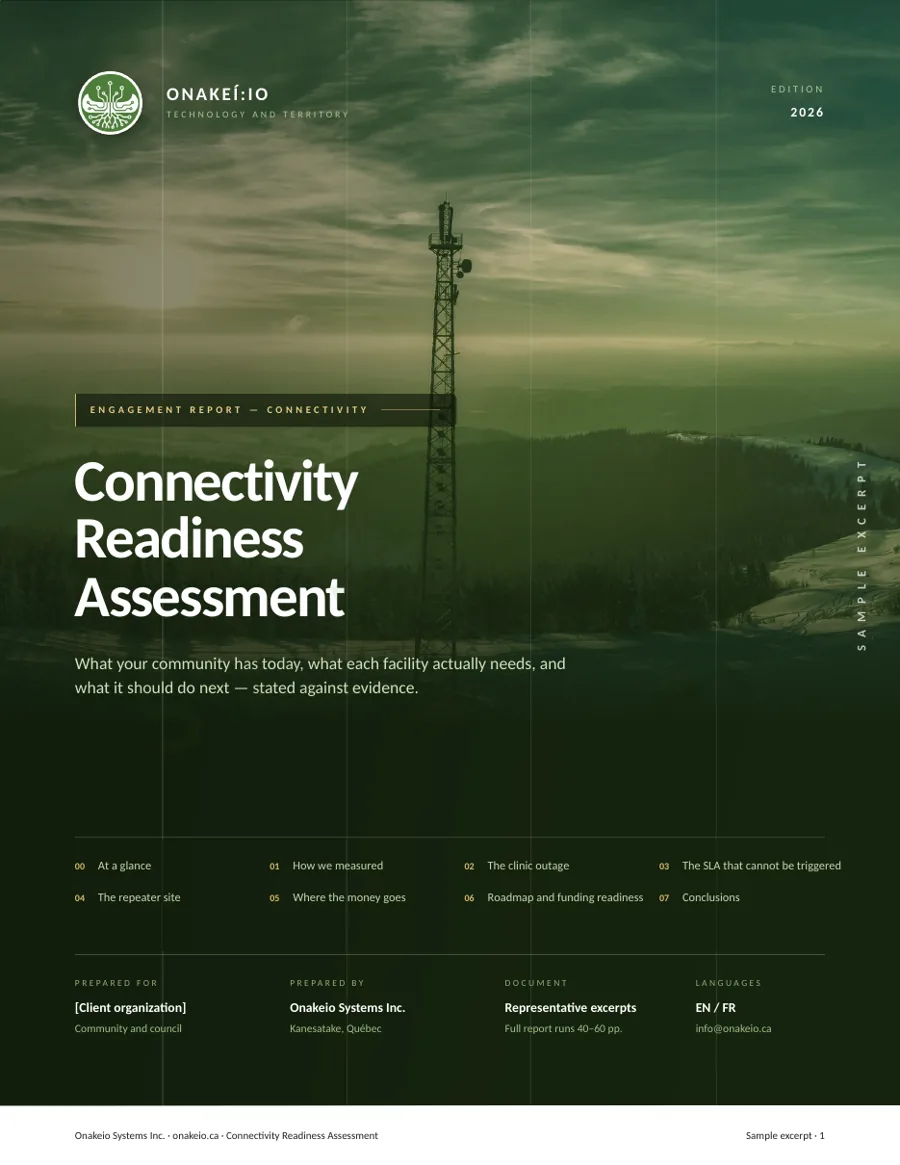
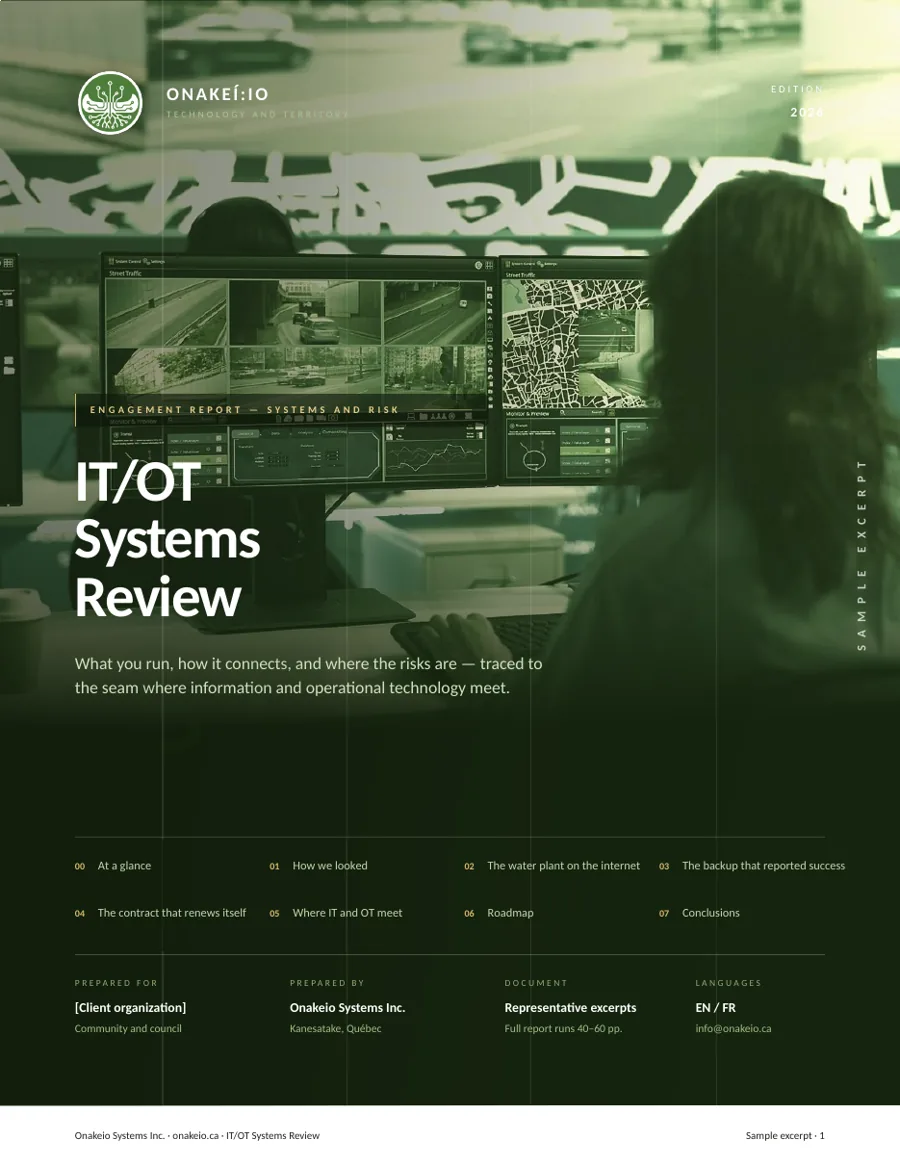
Each “Start here” assessment ends in a report like these: findings, figures and recommendations, in the layout a council or a funder receives. Ten to twelve pages, in English or French. Ask below and we email it to you.
Request a download
We email you a signed link, valid for seven days. Your address is used to send it, and for occasional notes only if you tick the box below.